Kids Will Love This Cooperative Shuttle Relay Approach
Shuttle relays are a team relay race during which the baton is carried end-to-end and exchanged between runners via a face-to-face pass. They are a great way to introduce relays to beginners and younger children.
Shuttle relays are also a wonderful way to provide children with a cooperative group experience, something that can be missing from the other traditional athletics events. Positive themes that can be emphasised through relay activities include teamwork, communication, helping others, and contributing to a group result.
But There Can Be a Problem
If we are trying to use relays to encourage cooperation within teams, while at the same time promoting competition between teams by determining a “winning” team, are we sending a mixed message?
If a group or class is already exhibiting negative behaviours caused by over-competitiveness, running relay races that results in a winning team can exacerbate the problem. The kids might start arguing about teams, blaming each other for mistakes, and focusing on who wins rather than how they work together.
Sometimes that competitiveness needs dampening down. What if a relay could build cooperation instead of rivalry?
A Cooperative Approach to Shuttle Relays
After being asked by a school if I could help them settle an overly competitive attitude within a certain class, I trialled a new relay teaching tactic.
I modified the shuttle relays to focus on a whole group or class-wide result rather than individual team victories. The effect was immediate. The kids concentrated on their own score as a contribution to a bigger result.
I now find this approach preferable than a “first team finished” situation.
How to Do It
- Set up a shuttle really run with teams of roughly the same size
- Ask the children to count the number of baton passes their team completes
- Add up the class total at the end.
- You can run the relay again and try to beat the class best.
As an optional skill extension, you can introduce the rule that if a relay baton is dropped during a pass, then that pass doesn’t count. This emphasises safe, smooth baton passes.
Add a Challenge or Mission
Kids love missions. Some examples are:
“Can your class complete 100 successful baton passes?”
“Can you beat your class record from last week?”
“Can every team improve their number of successful passes?”
Why the Concept Works
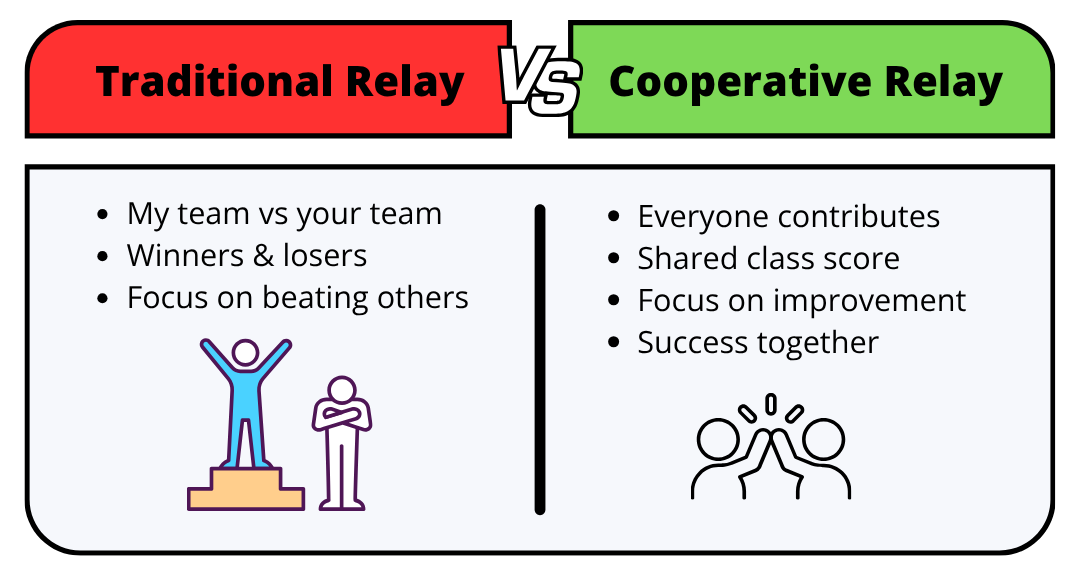
- Every team’s effort contributes to a shared result, so students see themselves as part of one big team (the class) rather than rival groups.
- Because there’s no single “winning team,” the pressure to beat others is reduced.
- By shifting success from “our team vs. their team” to “our class improving together,” the approach builds a culture of cooperation, mutual support, and personal best rather than rivalry.
- It does not matter if you are faced with unevenly matched teams or teams with uneven numbers. Each team runs for the same amount of time and no one finishes “first”.
How to Explain It
Here is an example of how you might introduce this concept to a group
“Today we’re going to do relays a bit differently. Instead of one team “winning,” our goal is for the whole class to work together.
- Each team will run a relay and try to make as many good passes as possible in the time we have.
- You will count your own team’s passes, and at the end, we’ll add all the teams’ scores together to make one big class total.
- That means every team’s effort helps our whole class result. If another team does well, that actually helps you too.
- Then we’ll try the relay again and see if, as a class, we can beat our first total.
So remember: We’re not trying to beat other teams. We’re trying to do our best, make clean passes, and help our whole class improve together.”
Include Reflection Questions
This is a great way to reinforce the lesson after the activity.
After the relay, ask:
- What helped our class improve?
- How did your team help the overall result?
- Did anyone encourage another team today?
- What could we do even better next time?
These questions help children connect the activity to teamwork and cooperation.
Conclusion
Relays are an exciting team event. To fully capitalise on their potential to create a cooperative environment and turbo charge team spirit, steer away from relays that determine a winner and opt for class-wide relay success over competition. The kids will love it.
Further Reading
7 Teaching Points for Shuttle Relays
If this post helped you please take a moment to help others by sharing it on social media. If you want to learn more I encourage you to leave questions and comments or contact me directly.

Darren Wensor is a sports development professional, coach educator, specialist coach of young athletes, and founder of the blog coachingyoungathletes.com. Learn more about him here and connect with him on Twitter, Facebook, Linkedin, or via email. Check out Coaching Young Athletes on YouTube, the Coaching Young Athletes podcast, and the Coaching Young Athletes E-Book Series.